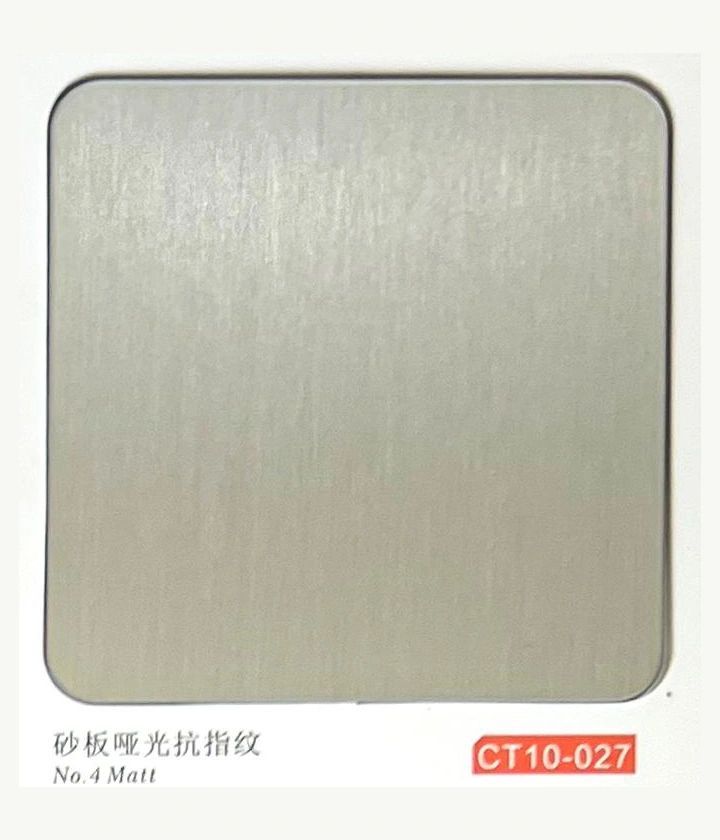
Record the location before cleaning
Photograph the whole part and the affected area. Note whether staining is concentrated near a weld, cut edge, fastener, sheltered joint or recent site work. Record the material identification and any cleaners used; this makes the supplier review more useful than a close-up without context.
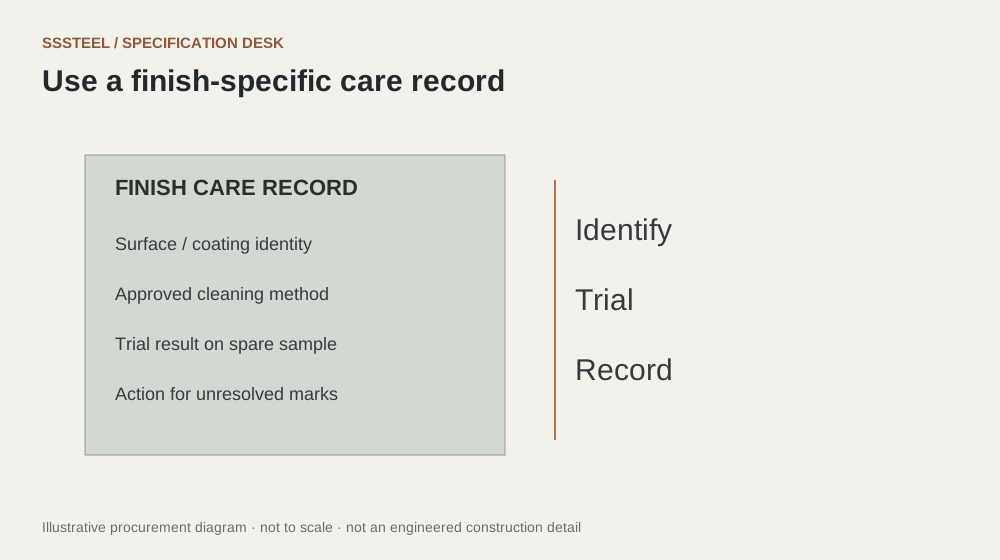
Distinguish appearance from diagnosis
An orange mark does not by itself establish the alloy or the mechanism. Outokumpu identifies fabrication contamination and inadequate post-fabrication cleaning as important contributors to problems. Other cases require assessment of the grade, environment and component geometry.
Agree the remedy for the finish
Do not start with abrasive polishing or acid treatment on a decorative surface. Ask the supplier or a qualified specialist to identify a compatible procedure. For coloured or coated material, a treatment suitable for bare stainless may alter the appearance or damage the finish.
| Decision | Put this in writing |
|---|---|
| Evidence | Record location, exposure and maintenance history. |
| Review | Check grade, contamination and detail geometry. |
| Remedy | Agree a finish-compatible treatment before work. |
Put the detail to work.
Rust-coloured marks appear after adjacent carbon-steel cutting work. Record the timing, locations and nearby operations before choosing a remedy. The evidence may help a specialist distinguish deposited contamination from another cause, but it is not a diagnosis by itself. Ask for a finish-compatible trial and document its outcome. Do not remove the visible evidence with aggressive polishing before the supplier has reviewed the affected parts.
Before you enquire
- Keep a sample of affected and unaffected areas documented.
- Identify nearby carbon-steel work.
- Record the outcome of any approved trial.
Technical references & editorial scope
- Outokumpu — Post-fabrication treatment ↗
Fabrication contamination and heat tint may require appropriate professional treatment. - Nickel Institute — Maintenance and finish selection ↗
Cleaning approach depends on surface; coloured finishes need supplier-specific guidance.
The checklists and buying example are original SSSTEEL editorial guidance. Project drawings, supplier documentation and the agreed order govern the actual supply. External references are not product endorsements or proof of SSSTEEL certification.