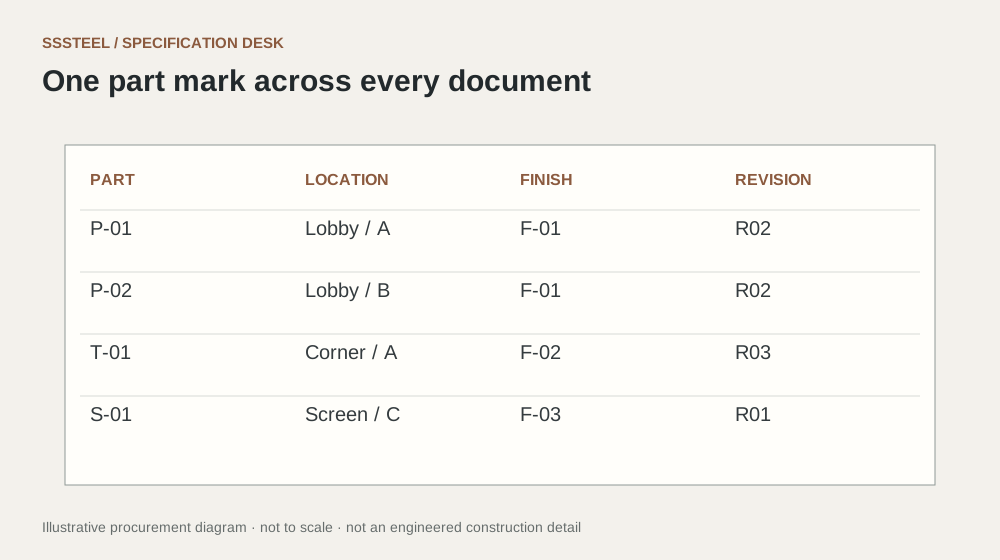
Keep the part dimensions
List each finished component and quantity. Include returns, folds and any additional material needed for fabrication as reviewed by the fabricator. Distinguish a visible front-face area from the developed blank used to make the part.
Review the cutting layout
Ask the supplier to consider available sheet formats, grain orientation, finish matching and cutting constraints. Two schedules with the same net area can require different parent-sheet quantities. Avoid applying a universal waste percentage without reviewing the actual layout.
Clarify ownership of remnants
If the quotation is based on parent sheets, ask how remnants and spare material are treated. Record whether they are included, retained or discarded under the agreement. Keep deliberate spare parts separate from incidental offcuts in the purchasing record.
A simple area calculation
Illustrative arithmetic only: twenty flat visible panels measuring 1,000 × 500 mm have a combined face area of 10 square metres. That number describes the visible rectangles. It does not include any returns, fabrication allowance, spare parts or unusable material around a cutting layout. It also does not prove that any particular parent-sheet format is available.
Why equal areas can buy different quantities
A set of long narrow pieces and a set of compact rectangles may have the same total area but fit parent sheets differently. Fixed grain direction reduces the permitted rotations. Matching requirements may also limit which pieces can share material from different batches. Request a proposed cutting basis for the actual part schedule instead of assuming that one percentage allowance works for every job.
How to read the quoted unit
Ask whether the price is per parent sheet, per square metre of supplied material, per finished panel or per fabricated set. Confirm what quantity is used for billing and which operations are included. Keep the net-area calculation for design and budgeting, while retaining the accepted purchasing basis in the order. This prevents a correct geometric calculation from becoming an incorrect commercial assumption.
| Decision | Put this in writing |
|---|---|
| Net area | Visible or finished component area. |
| Blank requirement | Material needed before forming and finishing. |
| Purchased quantity | Agreed parent sheets or supplied parts. |
Put the detail to work.
A schedule contains narrow trims and large panels with fixed grain direction. Ask for a cutting review rather than converting the combined net area directly into sheet quantity. The shapes and orientation constrain how they fit together. Keep agreed spare parts and remnants separately identified so the purchase quantity can be explained without an arbitrary waste allowance.
Before you enquire
- Provide dimensions instead of only square metres.
- Mark fixed grain orientation.
- Agree treatment of spares and remnants.
About this procurement note
The checklists and buying example are original SSSTEEL editorial guidance. Project drawings, supplier documentation and the agreed order govern the actual supply. External references are not product endorsements or proof of SSSTEEL certification.